
 English
 Français
 Español
 Deutsch
 Italiano
 Português
 Русский
 日本語
 中文
 한국어
 Polski
 Türkçe
 Nederlands
 Svenska
 Bahasa Indonesia
 Tiếng Việt
- Games teach best: vocabulary, listening and reading at beginner level.
- Games teach least: speaking freely and writing. Add real conversations later.
- Beginner? Pick a game made for learners. Intermediate? Switch your favourite video games to the language.
- Our game: Language Game — a pixel-art adventure in 16 languages, free to start, then €5 once.
Why games work for languages
Three things make a word stay in memory, and a game can give all three at once:
- Repetition spread over time. Seeing a word again just before you forget it is the most reliable finding in memory research (spaced repetition). A game brings words back naturally: you walk past the bakery again.
- Context. A word tied to a place, a picture and a sound has more hooks than a line in a list.
- A reason to continue. The best method is the one you are still using in three months. A world to finish does that better than a reminder.
The four kinds of language games
| Kind | What you do | Best for |
|---|---|---|
| Gamified lessons | Exercises with points, streaks and leagues | A daily habit; structured courses |
| Learning adventures | Explore a world where objects and people teach you words | Beginners who like real video games |
| Normal games in the target language | Play any video game with its language switched | Intermediate learners (about 1,000 words and up) |
| Multiplayer and voice | Talk with other players while playing | Getting over the fear of speaking |
How to choose one
- Check that every word has audio. A language learned without sound has to be relearned.
- For Japanese, Chinese, Korean or Russian, look for reading aids (furigana, pinyin, romanization, stress marks) that you can switch off later.
- Look for reviews of old words, not only new ones.
- Try before paying. A free start tells you in ten minutes whether you will come back.
- Look at the price model. A monthly subscription only pays off if you play every month. See learning without a subscription.
Five language learning games worth trying
Ours first, since you are on our site — then four by other studios that we find interesting. Check each one’s page for current platforms, languages and prices.
1. Language Game — a town that speaks your new language
A cozy pixel-art adventure for beginners. You scan things in town to get their name and voice, win the words in duels against rivals, and beat the master of each island. 722 everyday words in 32 themes, 7 islands, multiplayer rooms with voice chat. 16 languages, in the browser, free to start, then €5 once.
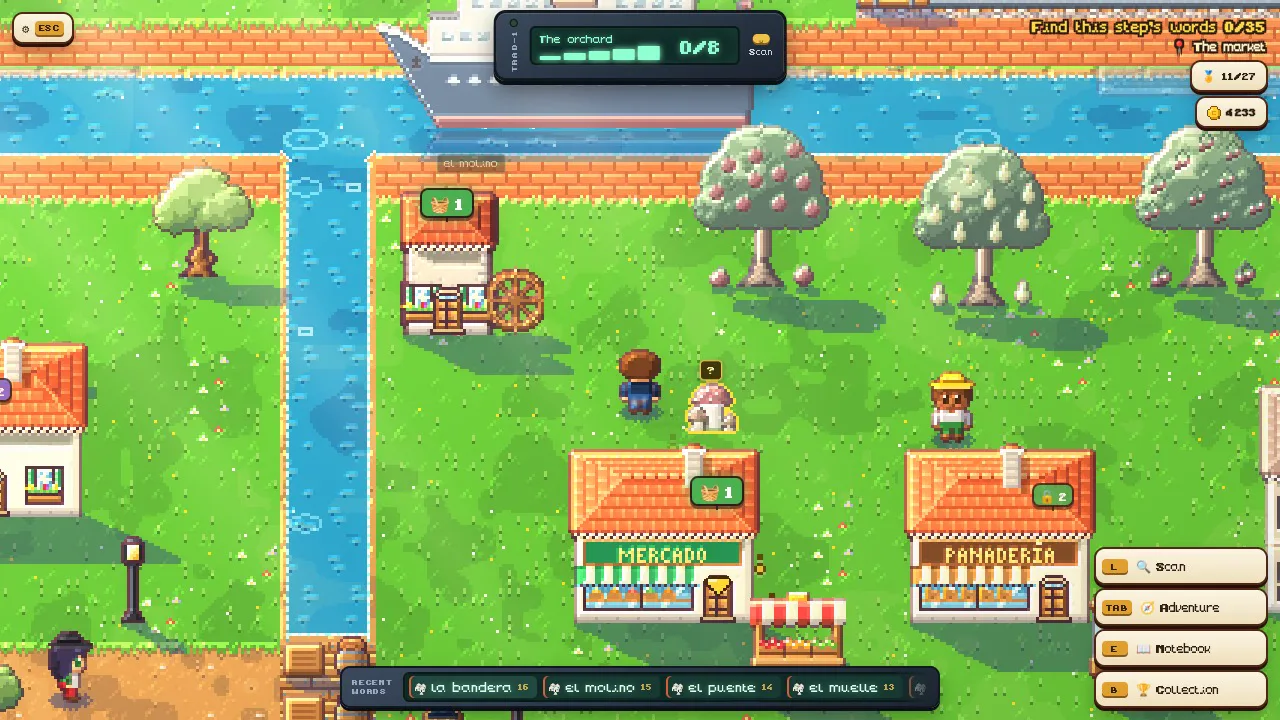
Free first island, no sign-up, nothing to install.
Play free2. Influent
You walk around a 3D apartment and click on objects to collect their names, then test yourself against the clock. Focused on vocabulary; each language is sold separately.
3. Noun Town
A town that regains its colours as you learn words, playable in virtual reality or on a screen, with speaking practice.
4. Shashingo
You take photos in a Japanese street and each photo becomes a flashcard with the word. Japanese only.
5. Lingo Legend
A card-battle adventure on phones where answering language questions powers your attacks.
What a game cannot do
- It will not make you fluent alone. The U.S. Foreign Service Institute counts 600 to 2,200 class hours to reach professional level, depending on the language. A game covers the first, most discouraging part.
- It will not speak for you. At some point you need real conversations: a tutor, an exchange partner, a trip.
- It will not fix irregular practice. Twenty minutes on most days is the rule that matters.
A simple plan
- Weeks 1–6: a learner’s game, 20 minutes a day, to get your first 500–700 words with their sound.
- From week 4: add ten minutes of easy listening (songs, children’s shows) in the language.
- From month 3: one conversation a week, and switch one game you already know to the language.
Start with the language you want: Spanish, French, Japanese, Korean, Chinese, German — or see how it compares with Duolingo.